
Picture this: you are in the Netherlands, the sun is finally out, and every canal-side terrace looks like the best seat in the country. But which cafes are actually worth your afternoon? That is exactly what this guide answers. We picked five real cafes with outdoor seating, one each in Amsterdam, Rotterdam, Utrecht, The Hague, and Groningen, so you can plan a trip without guessing.
First, we will explain how we picked these five cafes and what we actually checked. Then we will visit each spot, from a leaning lock house in Amsterdam to a former school in Rotterdam, a church courtyard in Utrecht, a sunny square in The Hague, and the north's biggest terrace in Groningen. After the list, we will cover Dutch terrace season and permits, answer common FAQ questions about shade, sun and terrace rules, and show you how to check the sun before you leave. Finally, we will wrap up with the takeaway: pick the hour, then pick the cafe. So grab a coffee, or a beer, and let's find your next outdoor table.
We picked one café per city. Two-thirds of Dutch consumers now say café prices are too high, so affordability was a filter, not an afterthought: we skipped anywhere a cheaper terrace a few streets away does the same job.
For each terrace we checked buildings within roughly 100 metres, worked out whether their height and footprint would shade the tables at a given hour, then layered the day's cloud and rain forecast on top. That is what LumoSpot does automatically.
Dutch people sit around nine hours a working day, and the Netherlands was named Europe's champion of sitting in a 2024 TNO study. These are five places to sit somewhere better, outdoors.
Amsterdam leads for two reasons: it is the capital, and it is the only city where LumoSpot is live today, so this sun data is real.
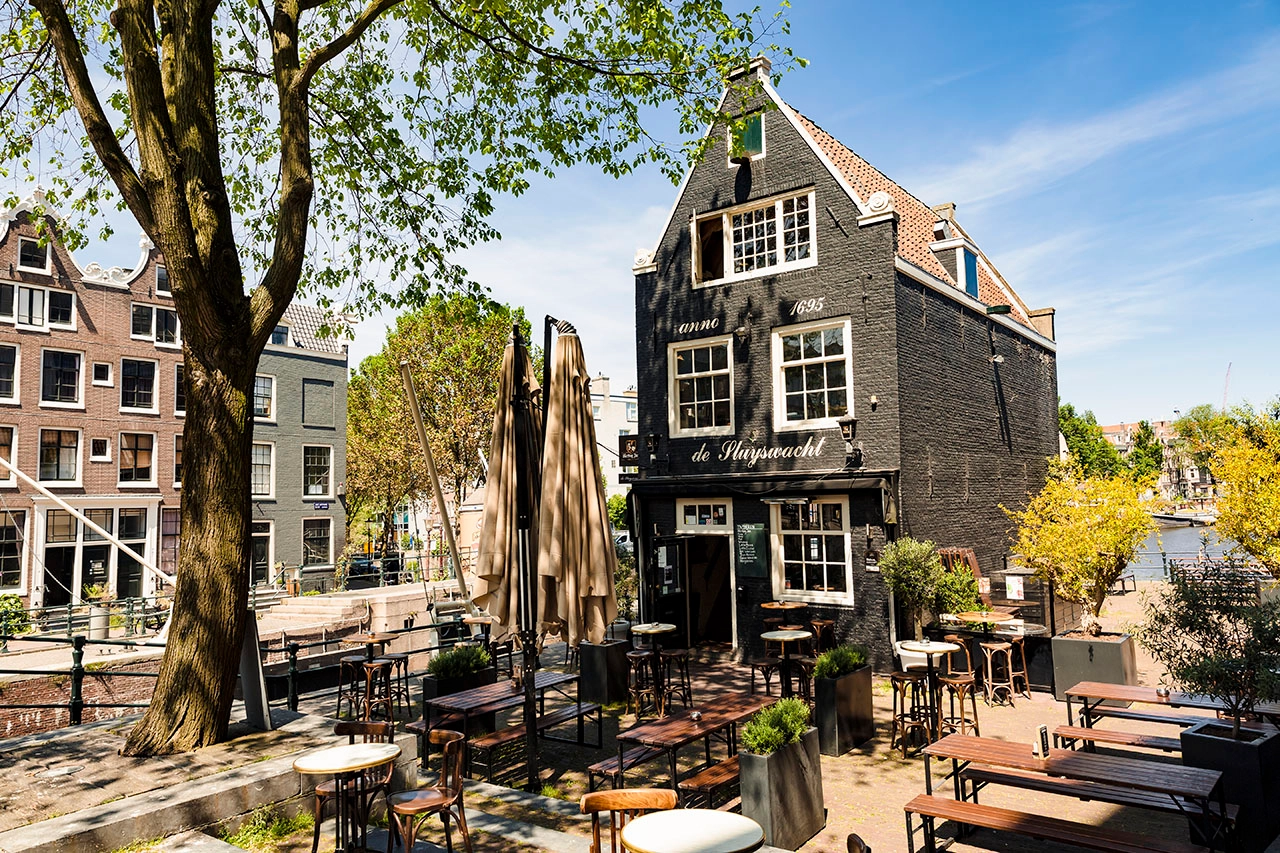
Cafe de Sluyswacht sits on the Oude Schans canal, five minutes from Nieuwmarkt metro: the historic lock-keeper's building visibly leans over the water, with a few tables along its canal-side edge.
The seating is tiny, unreserved and first come, first served, reached over uneven cobbles. No awning, so it is genuinely weather-dependent. For more Amsterdam picks, see our guide to the best restaurants with outdoor seating in Amsterdam.
The terrace looks west across the water, making late afternoon into early evening the real window. Far-bank buildings start cutting the light as the sun drops, the shadow geometry you can check before leaving home.
Order a pilsner at prices among the more affordable you'll find on a central Amsterdam canal terrace, plus bitterballen. Dutch hospitality prices sat about 25 percent above 2022 levels by late 2025.
Expect the busiest stretch between 16:00 and 18:00. No reservations, card and cash accepted, and check the venue's own site plus its OpenStreetMap tag for seasonal opening.
Amsterdam's postage-stamp canal terraces are charming, but tight. Rotterdam does the opposite.
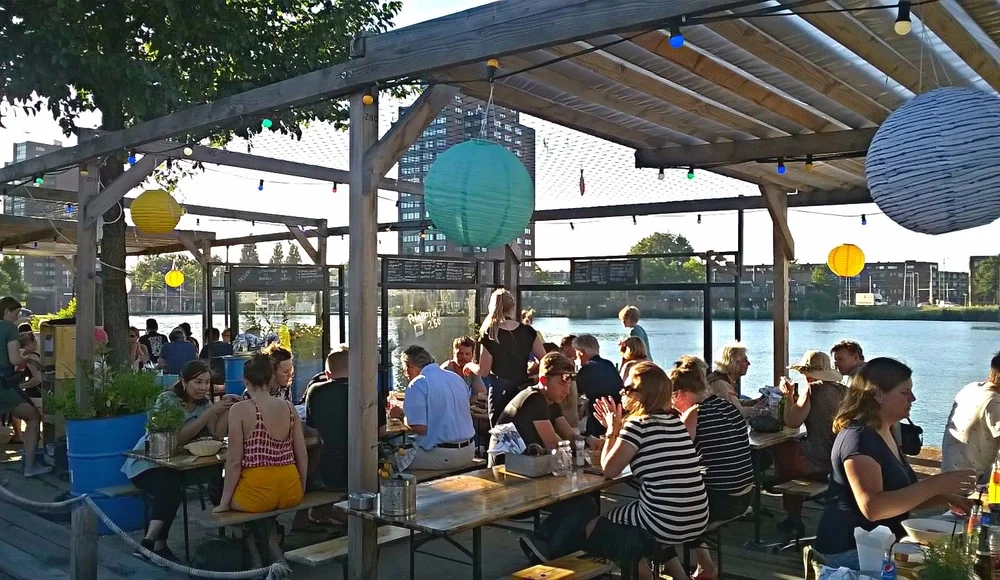
De Machinist sits in a repurposed school building in the Cool district near Museumpark and the Kunsthal. The terrace runs along the building's frontage rather than a canal.
Seating is generous: long benches and loose tables that suit groups, laptops before noon, families in the afternoon.
Sun-wise, it faces roughly south-west across open street space with little directly opposite, so light holds from early afternoon into early evening. That's unusual for a city terrace hemmed in by taller blocks. For more on how orientation changes everything, see Amsterdam's best sunny terraces: a neighbourhood guide.
Expect mid-range Rotterdam pricing. Getting there: Coolhaven or Eendrachtsplein. Thursdays and Fridays bring after-work crowds. Check the venue's own opening hours and its OSM outdoor_seating tag before you go.
Rotterdam's benches win on space, but for a courtyard instead of a street frontage, Utrecht has the better story.
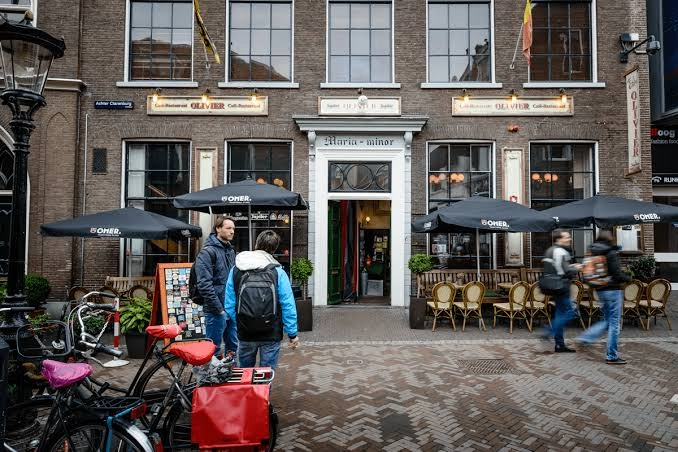
Café Olivier sits at Achter Clarenburg 6, roughly a six-minute walk from Utrecht Centraal, inside a converted schuilkerk, a clandestine church that never looked like one from the street. Outdoor seating availability should be confirmed on the venue's own site before visiting.
Seating splits between any open-air tables and the covered church interior, making this the most weather-forgiving pick here if a shower rolls through.
Sun here is a midday affair. A tall building flanks one side, lower walls the others, so light reaches the tables from late morning into early afternoon, before the church wall casts across them.
The draw is a long Belgian beer list with proper glassware, plus a solid lunch menu. It's a beer destination, so budget for rounds.
It's 5 to 8 minutes from the station, and tables fill fast on sunny weekend afternoons. The Oudegracht wharf cellars nearby follow their own terrace rules. Chasing sun in Amsterdam instead? Our happy hour terrace guide covers a different part of the day.
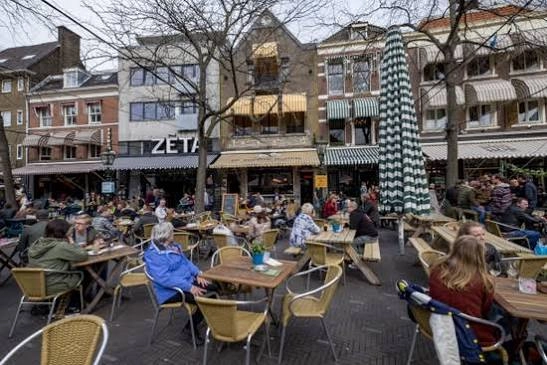
De Zwarte Ruiter sits at Grote Markt 27, on The Hague's main square. It's part of a cluster of bars whose terraces together form one of the city's largest outdoor drinking areas, and it's been a live music café since 1988.
The terrace runs along an open square frontage with plenty of tables, and the large terrace gives groups a better chance of walk-in seats than smaller canal-side venues.
The open square aspect means the terrace benefits from sun for much of the day, though you should confirm exact orientation with a sun-check tool. The only real shadow comes later, as the buildings along the square's edge start blocking when the sun swings west.
Live music several evenings a week makes it louder and later than the rest.
It's a short walk from Den Haag Centraal and the city centre tram lines. Friday and Saturday evenings are packed, and square terraces are noticeably noisier than canal-side ones. Want a quieter early round? Our guide to the best bars with outdoor seating for happy hour in Amsterdam has options.
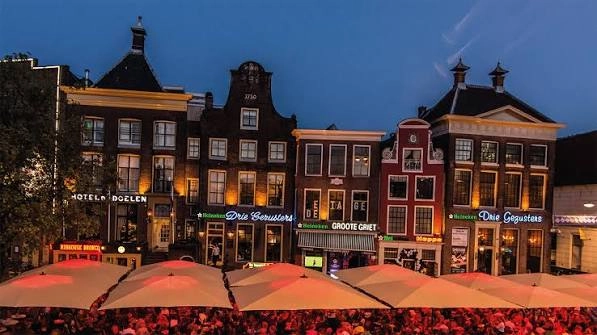
Groningen swaps The Hague's noise for something roomier.
De Drie Gezusters fills Grote Markt 36-39 (sources disagree slightly on the number, so check before you go), the central square, and is the obvious first stop for anyone new to the city. The venue claims to be Europe's largest café, and the terrace sprawls across the square frontage with dozens of tables, room for groups, and a choice between sun and shade depending on which side you sit.
The square opens south and south-west, so light lands from late morning and holds well into the evening, while nearby buildings determine where shade falls as the day progresses.
A short walk from Groningen station and a natural stop on a city walk. It also shows why orientation matters, since two terraces on one square can differ by hours of sun depending on what stands south of them. For the same logic applied elsewhere, see Amsterdam's best sunny terraces.
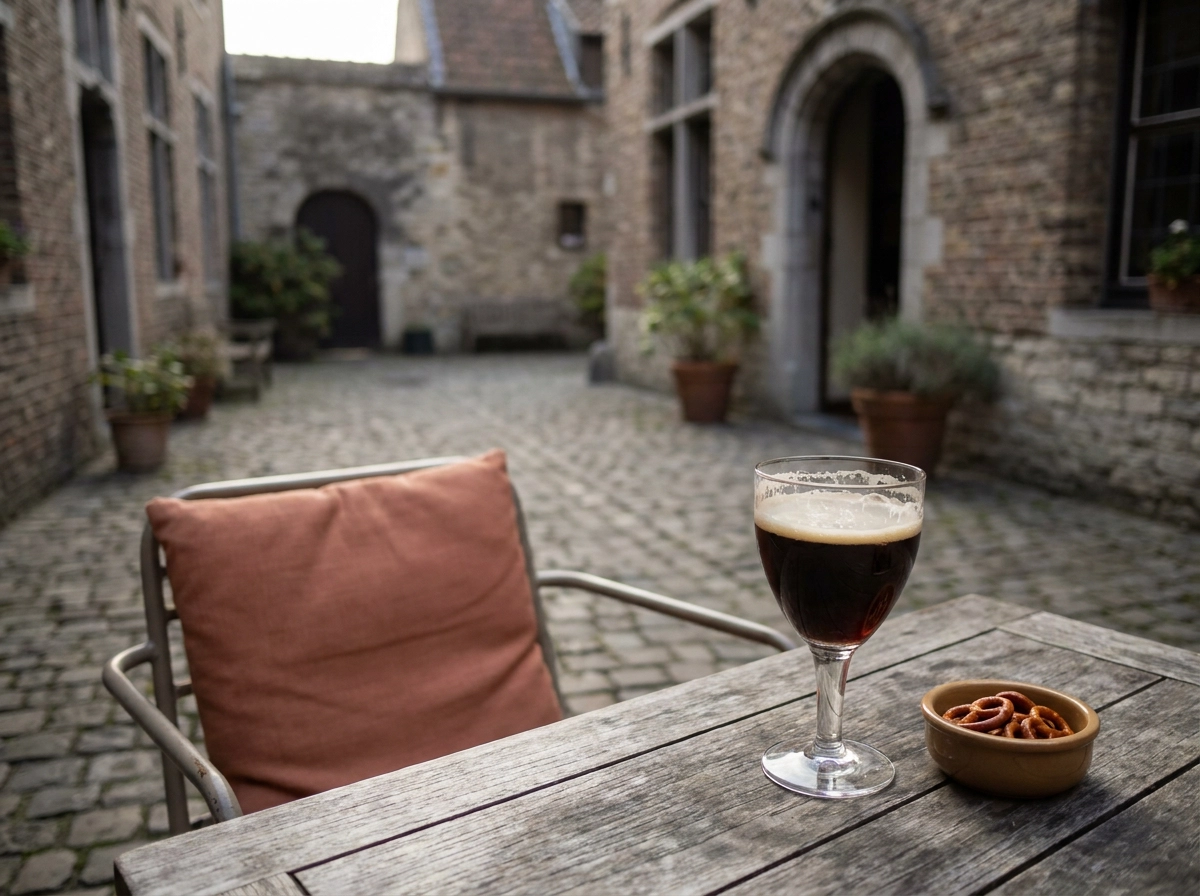
Before you plan a trip around any of these five, know that Dutch terraces are seasonal and permission-dependent.
The season broadly runs spring to autumn, and many municipalities set exact dates in local bye-laws. Extensions, heaters and windbreaks usually need permission, and some cities allow year-round terraces while others don't. A terrace also needs its own permit, often called a terrasvergunning, linked to the venue's location, with limits on how much pavement it can use.
Local rules decide what you actually see: noise limits, cut-off times for amplified music, caps on windbreak height and marked furniture zones that cafes can't exceed. Utrecht's Oudegracht wharf terraces are a separate category, sitting on the wharf rather than at street level, so the permit conditions governing street-level terraces may differ from those at wharf level, check with the venue.
The takeaway: a terrace that's full in June may be packed away in November. Check the venue's own site for seasonal dates, and treat this list as a starting point rather than a guarantee.
For live sun checks in the capital, see how to find a sunny terrace by neighbourhood.
You have the permits and seasons covered. Here is the rest, short and practical.
Is this terrace sunny right now? Not automatically, even under a clear sky. A building within roughly 100 metres can block the sun from a seating area at a given hour, so two terraces a street apart can feel completely different at once.
Does the forecast change that? No. Weather only refines a result that is already sunny. Cloud and rain can downgrade a geometrically sunny slot to partly sunny, cloudy or rainy, but a shaded terrace stays shaded whatever the forecast says.
When is terrace season? Broadly spring to autumn, though each municipality sets its own dates and some cities permit terraces all year.
Do cafes charge extra to sit outside? No cover charge at the venues on this list. You pay menu prices, and tipping is optional rather than expected.
Planning ahead still helps: why Dutch calendars fill up before your sunny terrace does.
The list above gets you to a good terrace. It cannot tell you whether that terrace is in the sun at 15:00 today, because that depends on the hour and the buildings around it.
That is the gap LumoSpot fills. It shows which Dutch venues with outdoor seating are in direct sun right now, or will be later today. For each venue it combines precise sun position with the height and footprint of buildings within 100 metres, then layers a live Open-Meteo forecast on top. Prefer geometry only? The Include weather toggle switches the forecast refinement off.
Rule of thumb from our five picks: west-facing canal terraces, like De Sluyswacht, pay off late afternoon. South-facing square terraces, like Grote Markt in The Hague and Groningen, pay off from late morning.
See our Dutch coverage for live results, and the explainer on remaining versus total sun exposure if you want the full method.
The five best Dutch terraces are less about luck and more about timing. The orientation and timing logic from the guide above applies across all five. So pick your hour, check the venue's orientation, and choose the terrace that fits. Your perfect sunny table is not far away. Go find it.