

Picture this: a cold January day in Amsterdam, but you're sitting outside on a terrace with the sun on your face. Sounds too good to be true? It isn't. Finding a sunny terrace in Amsterdam in winter is simply a matter of having the right information.
Most terrace guides stop at September. After that? Silence. But winter sun doesn't just disappear, it just needs a smarter approach. In winter the sun sits low in the sky, so even small buildings cast big shadows. That sounds discouraging, but it has an upside too. That same sun position makes it very predictable when a specific terrace actually is in the sun.
In this article we explain why winter sun in Amsterdam feels so different, how shadows are really just math, and how LumoSpot turns that knowledge into concrete, usable information. Whether you want to lunch outside in October or grab a drink in February, by the end you'll know exactly what to look for.
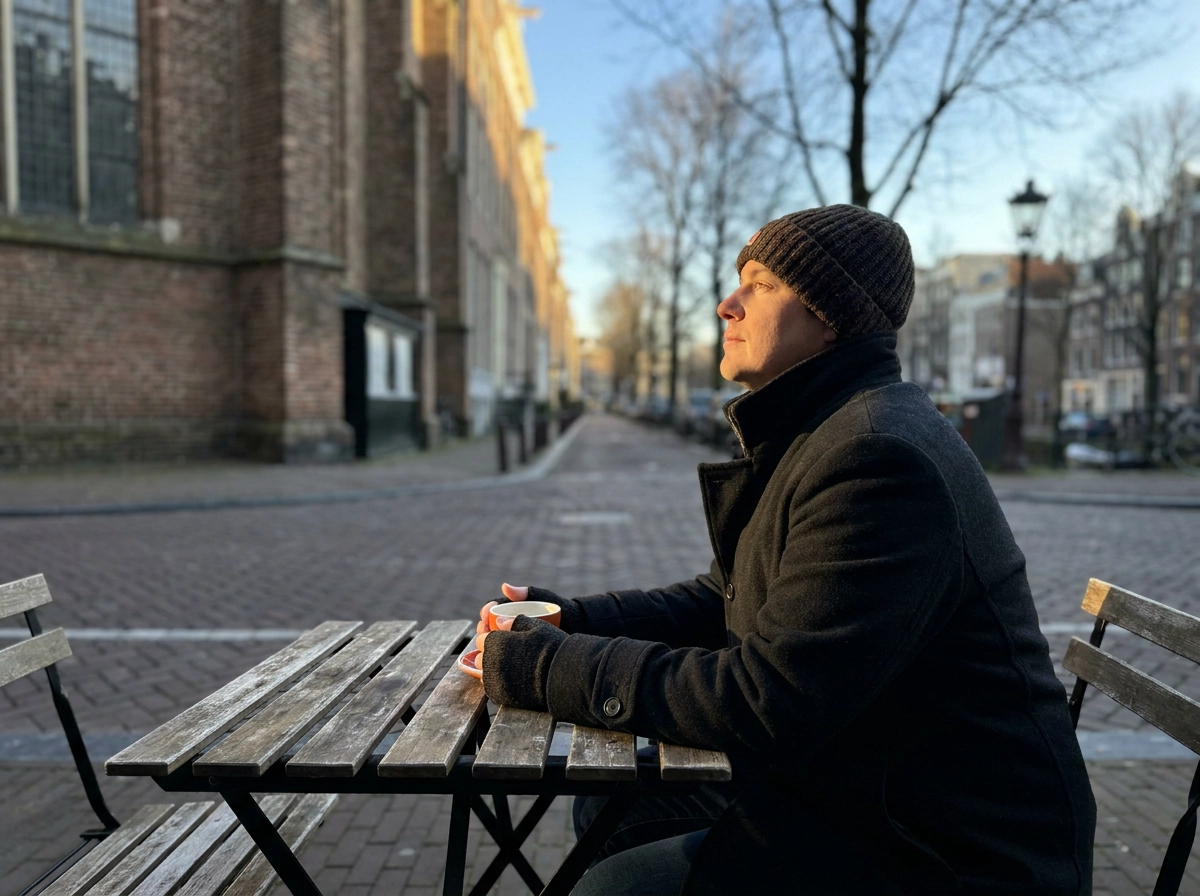
Know that feeling? You're walking through Amsterdam in January, it's chilly but the sun is out, and you spot someone sitting outside on a terrace with a cup of coffee. How do they manage that? The answer lies in the math of winter.
Amsterdam sits at latitude 52.4°N, and that makes winter sun fundamentally different from what you're used to in summer. In June the sun reaches its highest point at around 61 degrees above the horizon. In December that's only 14 to 17 degrees. Less than a quarter turn upward. That's not a bit lower, it's a completely different sun.
That low angle has direct consequences for every terrace in the city. When sunlight falls in nearly horizontal, every building casts an enormous shadow. A two-storey building, roughly six to seven metres tall, can cast a shadow ten to fifteen metres long in December. Enough to cover an entire terrace at once.
That terrace you saw bathed in sun all afternoon in August? In December it's already in the shadow of the building across the street by 13:00. Not because anything changed about the terrace, but because the sun follows a completely different path.
Most terrace guides don't account for this. They simply stop at September and leave you guessing in November and February. On the LumoSpot blog you'll see it can be done differently.
Here's the good news though: winter sun feels unpredictable, but it isn't. The position of the sun can be calculated to the minute for any moment of the year. Shadow isn't chance, it's geometry.
That's exactly right: sun position isn't a feeling, it's astronomy. For any location on earth, at any moment of the day, the sun's height above the horizon and its direction (azimuth) can be calculated to the minute. That's true for a summer day in July, but just as true for an ordinary Tuesday in February.
Now it gets interesting. Once you combine that sun position with the height and footprint of the buildings around a terrace, you know exactly when a building casts its shadow over that terrace. No guesswork, just geometry.
At latitude 52.4°N, the sun traces a low, narrow arc across the sky in winter. It rises late in the southeast, reaches its highest point in the mid-afternoon, and sets early in the southwest. That path is nearly identical every day, with only a small shift from day to day.
That limited arc has a direct consequence for every terrace in the city. Between the buildings, there's a narrow window of time for each location when the sun has unobstructed access, sometimes just two hours a day. But those two hours fall at almost the same moment every day. Wednesday or Friday, week one or week three: the shadow follows the same logic.
Shadow geometry is therefore the opposite of chance. It's reproducible, verifiable and fully plannable. Once you understand how it works, you can predict exactly when a specific terrace is in the sun. How LumoSpot puts that into practice is covered in the next section.
That predictability is exactly what makes LumoSpot practically useful.
For every registered terrace in Amsterdam, LumoSpot calculates which shadows the surrounding buildings cast, at every time of day. The foundation: open building data with heights and footprints, such as those available via the City of Amsterdam's data portal. All buildings within a 100-metre radius around a terrace are included. That might sound generous, but in Amsterdam narrow alleys and tall side walls are the norm. Without that 100-metre radius, you'd miss exactly the facades that suddenly cast a terrace into shadow at 13:00.
Shadow geometry answers one specific question: would the sun reach here if the sky were clear? That's valuable information, but it says nothing about clouds or rain.
For that, LumoSpot adds a second layer: a live weather forecast via Open-Meteo. Cloud cover and precipitation refine a geometrically sunny moment into sunny, partly cloudy, cloudy or rainy. A terrace that's geometrically in shadow stays in shadow, regardless of the weather. Weather can only refine an already-sunny result, never reverse it.
Using the "Include weather" toggle you switch between the two layers. Turn it on, and only actually sunny or partly cloudy time counts. Turn it off, and you see pure shadow geometry: handy if you want to find a terrace for next week without depending on a forecast that might still change in five days' time.
That way you combine the certainty of math with the reality of Amsterdam weather. You can read more about how LumoSpot handles your data in the privacy statement and terms and conditions.
That shadow and weather data LumoSpot calculates translates into two concrete numbers per terrace. Total sun is the total amount of qualifying sun time over a full day, no matter what time you check. Remaining sun is how much of that sun time is left from now until the end of the day.
In summer that distinction barely matters. A terrace with six or seven hours of total sun always has another sunny stretch ahead, even if you only decide to head out at three in the afternoon.
In winter it's fundamentally different.
Say a terrace has two hours of total sun, somewhere between 12:00 and 14:00. If you check LumoSpot at 14:15, remaining sun is zero. The sun has already dropped behind the building next door and won't come back. Too late, for today.
Remaining sun is therefore the most urgent metric in winter. It answers exactly the question you ask on a rare sunny November day: is it still worth getting on your bike right now? One number, an immediate answer.
Total sun is useful for a different situation: planning ahead. Which terraces are structurally worth it on short winter days? Not based on a feeling or a friend's tip, but on geometry. A terrace with a consistent two hours of total sun is a good choice every day, as long as you go at the right moment.
Both metrics respond to the weather toggle. Turn it on, and only actually sunny or partly cloudy time counts. Turn it off, and all shadow-free time counts, regardless of the forecast. Handy if you're planning a day ahead and don't want to put too much faith in a weather model from 48 hours out.
But data alone doesn't make winter sun appealing. That needs a more honest argument.
A sunny January afternoon on an Amsterdam terrace has something a summer day simply doesn't. It's quieter, the city breathes differently, and that scarce sun feels more earned than the seventh sunny day in August. You're not caught up in the crowds; you have the terrace almost to yourself.
Amsterdam's hospitality businesses have known this for a long time. Many terraces stay open all year, equipped with heat lamps and stacks of blankets, precisely because there's an audience that wants to sit outside in winter too. That offer already exists; the only thing missing is a way to know which terrace is worth it at what moment.
And here's the key: the brevity of winter sun is also its biggest advantage. Those narrow sunny windows fall at almost the same time every day, in almost the same spot. Shadow geometry doesn't change from day to day. If you know a terrace along the Amstel is in the sun every day between 12:00 and 14:00, you can simply plan around it, as if it were an appointment.
That's what makes eating outside in Amsterdam in winter genuinely enjoyable too. It's a reason to head into the city on a day you'd otherwise stay on the couch. A goal, a destination, a reward.
And that's exactly where this story is headed: eating outside in the sun in Amsterdam in winter isn't a matter of luck or years of local knowledge. It's a matter of checking the right data at the right moment.
Checking the right data sounds great, but how do you actually do it? Here's how.
Open LumoSpot on a day with sun or partial cloud. Want to plan purely on geometry, without depending on the weather forecast? Then turn the weather toggle off. You'll then see all shadow-free time windows, regardless of what the sky is doing.
Check the remaining sun value first. More than an hour left? That terrace is interesting right now. Showing zero? Then that spot is done for the day. In winter, this is the fastest way to decide right away whether it's still worth heading out.
Use total sun for planning ahead. A terrace with two hours of total sun is a fine choice on a winter day, as long as you go there between 12:00 and 14:00. Outside that window, you're likely to end up in the shade.
Pay attention to the terrace's orientation. South- and southwest-facing terraces structurally have the best odds in winter. The sun hangs low in the south and traces a short arc; a terrace facing that way catches the most of it.
Make it a weekly habit. Check on Monday evening which terrace has the most sun time around lunchtime on Tuesday, and plan your get-together there. Two minutes of work, and a lot more pleasant than discovering afterwards that you're sitting in the shade.
And don't forget small terraces. A narrow bench against the wall of a brown café can, geometrically speaking, catch more winter sun than a big terrace square on the north side of a tall building. Size says little; orientation and surroundings say everything.
Everything you've read in this article comes together in one simple insight: winter sun on an Amsterdam terrace isn't unfindable, it just requires better information than any summer terrace guide could ever offer.
That better information starts with shadow geometry. By combining building heights and footprints with the exact position of the sun, it's possible to calculate, using a model, when a specific terrace is in the sun, even on a cold February morning or a grey December afternoon.
The metrics total sun and remaining sun make that concretely usable. In summer there's enough sun time to make mistakes. In winter there isn't. Remaining sun tells you right now whether a terrace is still worth it; total sun helps you plan ahead. Two numbers that suddenly carry a lot more weight in October than they do in July.
But geometry alone isn't enough. On top of that, LumoSpot adds a live weather layer via Open-Meteo, so you know not just when the sun theoretically shines, but when it actually does. A cloudy day stays cloudy, but a geometrically sunny moment on a clear day gets its confirmation.
Winter sun in Amsterdam is short, low and beautiful if you know how to catch it. It won't wait until you're ready. Check lumospot.com and see straight away which terrace is in the sun right now. Coat on, coffee ordered, enjoy.
Winter sun in Amsterdam is scarce, but not unpredictable. The low sun angle, early sunset and surrounding buildings make orientation and shadow geometry decisive, not luck. With the metrics total sun and remaining sun you know exactly when a terrace is worth it, even on a cold December day. And combined with live weather data, that theoretically sunny moment gets confirmed for real too.
The difference between a disappointment and a perfect winter lunch outdoors comes down to having the right information at the right moment. That information is available.
Don't guess. Check lumospot.com, see which terrace is in the sun right now, and plan your visit with confidence. Because Amsterdam's winter sun doesn't last long, but whoever finds it enjoys it twice as much.
Stel je voor: een koude januaridag in Amsterdam, maar jij zit buiten op een terras met de zon op je gezicht. Klinkt te mooi om waar te zijn? Dat is het niet. Een zonnig terras in Amsterdam vinden in de winter is gewoon een kwestie van de juiste informatie hebben.
De meeste terrasgidsen houden op bij september. Daarna? Stilte. Maar de winterzon verdwijnt niet zomaar, ze vraagt alleen om een slimmere aanpak. In de winter staat de zon laag aan de hemel, waardoor zelfs kleine gebouwen grote schaduwen gooien. Dat klinkt ontmoedigend, maar het heeft ook een keerzijde. Diezelfde zonspositie maakt het namelijk heel goed voorspelbaar wanneer een specifiek terras wél in de zon ligt.
In dit artikel leggen we uit waarom winterzon in Amsterdam zo anders aanvoelt, hoe schaduwen eigenlijk gewoon wiskunde zijn en hoe LumoSpot die kennis omzet in concrete, bruikbare informatie. Of je nu buiten wilt lunchen in oktober of een drankje wilt doen in februari, na het lezen weet je precies waar je op moet letten.
Ken je dat gevoel? Je loopt in januari door Amsterdam, het is fris maar de zon schijnt, en je ziet iemand buiten zitten op een terras met een kop koffie. Hoe doet die persoon dat? Het antwoord zit in de wiskunde van de winter.
Amsterdam ligt op breedtegraad 52.4°N, en dat maakt de winterzon fundamenteel anders dan wat je in de zomer gewend bent. In juni staat de zon op zijn hoogst rond 61 graden boven de horizon. In december is dat nog maar 14 tot 17 graden. Minder dan een kwartslag omhoog. Dat is niet een beetje lager, dat is een compleet andere zon.
Die lage stand heeft directe gevolgen op elk terras in de stad. Wanneer zonlicht bijna horizontaal invalt, werpt elk gebouw een enorme schaduw. Een pand van twee verdiepingen, pakweg zes tot zeven meter hoog, kan in december een schaduw werpen van tien tot vijftien meter lang. Genoeg om een heel terras in één keer te bedekken.
Dat terras dat jij in augustus de hele middag in de zon zag liggen? In december ligt het al om 13:00 in de schaduw van het pand aan de overkant. Niet omdat er iets veranderd is aan het terras, maar omdat de zon een totaal ander pad bewandelt.
De meeste terrassengidsen houden hier geen rekening mee. Ze stoppen simpelweg bij september en laten je in november en februari raden. Op de LumoSpot blog zie je dat dit anders kan.
Want hier is het goede nieuws: winterzon voelt onvoorspelbaar, maar dat is het niet. De positie van de zon is op elk moment van het jaar tot op de minuut nauwkeurig te berekenen. Schaduw is geen toeval, het is geometrie.
Dat klopt dus precies: zonspositie is geen gevoel, het is astronomie. Voor elke locatie op aarde, op elk moment van de dag, is de hoogte van de zon boven de horizon én de richting (azimut) tot op de minuut nauwkeurig te berekenen. Dat geldt voor zomers in juli, maar net zo goed voor een doordeweekse dinsdag in februari.
Nu wordt het interessant. Zodra je die zonspositie combineert met de hoogte en footprint van gebouwen rondom een terras, weet je exact op welk moment een gebouw zijn schaduw over dat terras werpt. Geen giswerk, gewoon meetkunde.
Op breedtegraad 52.4°N trekt de zon in de winter een lage, smalle boog over de hemel. Ze komt laat op in het zuidoosten, bereikt haar hoogste punt halverwege de middag, en verdwijnt vroeg in het zuidwesten. Dat pad is elke dag nagenoeg identiek, met alleen een kleine verschuiving van dag tot dag.
Die beperkte boog heeft een directe consequentie voor elk terras in de stad. Tussen de gebouwen door bestaat er voor elke locatie een smal tijdvenster waarop de zon ongehinderd toegang heeft, soms maar twee uur per dag. Maar die twee uur vallen elke dag op vrijwel hetzelfde moment. Woensdag of vrijdag, week één of week drie: de schaduw volgt dezelfde logica.
Schaduwgeometrie is daarmee het tegenovergestelde van toeval. Het is reproduceerbaar, controleerbaar en volledig planbaar. Begrijp je hoe het werkt, dan kun je precies voorspellen wanneer een specifiek terras in de zon ligt. Hoe LumoSpot dat in de praktijk doet, komt in het volgende onderdeel aan bod.
Die berekenbaarheid is precies wat LumoSpot praktisch bruikbaar maakt.
Voor elk geregistreerd terras in Amsterdam berekent LumoSpot welke schaduwen omliggende gebouwen werpen, op elk tijdstip van de dag. De basis: open gebouwdata met hoogtes en footprints, zoals beschikbaar via het dataportaal van de Gemeente Amsterdam. Alle gebouwen binnen een straal van 100 meter rondom een terras worden meegenomen. Dat klinkt misschien ruim, maar in Amsterdam zijn smalle steegjes en hoge zijgevels de norm. Zonder die 100-meterstraal mis je precies de gevels die een terras om 13:00 uur plotseling in de schaduw leggen.
Schaduwgeometrie beantwoordt één specifieke vraag: zou de zon hier komen als de lucht helder was? Dat is waardevolle informatie, maar het zegt niets over bewolking of regen.
Daarvoor voegt LumoSpot een tweede laag toe: een actuele weersvoorspelling via Open-Meteo. Bewolking en neerslag verfijnen een geometrisch zonnig moment naar zonnig, gedeeltelijk bewolkt, bewolkt of regenachtig. Een terras dat geometrisch in de schaduw ligt, blijft schaduw, ongeacht het weer. Weer kan alleen een al-zonnig resultaat verder verfijnen, nooit omdraaien.
Via de "Inclusief weer"-toggle schakel je tussen de twee lagen. Zet je hem aan, dan telt alleen daadwerkelijk zonnige of gedeeltelijk bewolkte tijd mee. Zet je hem uit, dan zie je pure schaduwgeometrie: handig als je een terras voor volgende week wilt vinden zonder afhankelijk te zijn van een weersvoorspelling die over vijf dagen toch nog verandert.
Zo combineer je de zekerheid van wiskunde met de realiteit van het Amsterdamse weer. Meer over hoe LumoSpot met jouw gegevens omgaat lees je in de privacyverklaring en de algemene voorwaarden.
Die schaduw- en weerdata die LumoSpot berekent, vertalen zich naar twee concrete getallen per terras. Total sun is de totale hoeveelheid kwalificerende zontijd op een volledige dag, ongeacht hoe laat je kijkt. Remaining sun is hoeveel van die zontijd er nog over is vanaf nu tot het einde van de dag.
In de zomer maakt dat onderscheid weinig uit. Een terras met zes of zeven uur total sun heeft altijd nog een volgende zonnige periode, ook als je pas om drie uur 's middags besluit ergens naartoe te gaan.
In de winter is dat fundamenteel anders.
Stel: een terras heeft twee uur total sun, ergens tussen 12:00 en 14:00. Als je om 14:15 op LumoSpot kijkt, is de remaining sun nul. De zon is al achter het pand ernaast gezakt en komt niet meer terug. Te laat, voor vandaag.
Remaining sun is daarmee in de winter de meest urgente metric. Het beantwoordt precies de vraag die je op een schaarse zonnige novemberdag stelt: heeft het nu nog zin om op de fiets te stappen? Eén getal, direct antwoord.
Total sun is nuttig voor een andere situatie: vooruitplannen. Welke terrassen zijn op korte winterdagen structureel de moeite waard? Niet op basis van gevoel of een tip van een vriend, maar op basis van geometrie. Een terras met consequent twee uur total sun is elke dag een goede keuze, zolang je op het juiste moment gaat.
Beide metrics reageren op de weerstoggle. Zet je die aan, dan telt alleen daadwerkelijk zonnige of gedeeltelijk bewolkte tijd mee. Zet je hem uit, dan telt alle schaduwvrije tijd, ongeacht de voorspelling. Handig als je een dag vooruit plant en niet al te veel waarde hecht aan een weersmodel van 48 uur later.
Maar data alleen maakt winterzon nog niet aantrekkelijk. Daarvoor is een eerlijker argument nodig.
Een zonnige januarimiddag op een Amsterdams terras heeft iets wat een zomerse dag simpelweg niet heeft. Het is rustiger, de stad ademt anders, en die schaarse zon voelt meer verdiend dan de zevende zonnige dag in augustus. Je zit er niet tussen de drukte; je hebt het terras bijna voor jezelf.
Amsterdamse horecaondernemers weten dit allang. Veel terrassen blijven het hele jaar open, uitgerust met warmtelampen en stapels dekens, precies omdat er een publiek is dat ook in de winter buiten wil zitten. Dat aanbod is er al; het enige dat ontbreekt is een manier om te weten welk terras op welk moment de moeite waard is.
En hier zit de sleutel: de kortheid van winterzon is ook haar grootste voordeel. Die smalle zonnige vensters vallen elke dag op nagenoeg hetzelfde tijdstip, op nagenoeg dezelfde plek. Schaduwgeometrie verandert niet van dag tot dag. Wie weet dat een terras aan de Amstel elke dag tussen 12:00 en 14:00 in de zon ligt, kan daar gewoon rekening mee houden, alsof het een afspraak is.
Dat maakt buiten eten in Amsterdam in de winter ook gewoon leuk. Het is een reden om de stad in te gaan op een dag waarop je anders op de bank zou blijven. Een doel, een bestemming, een beloning.
En dat is precies waar dit verhaal naartoe werkt: zonnig buiten eten in Amsterdam in de winter is geen kwestie van geluk of jarenlange lokale kennis. Het is een kwestie van de juiste data raadplegen op het juiste moment.
Die juiste data raadplegen klinkt mooi, maar hoe doe je dat in de praktijk? Zo werkt het.
Open LumoSpot op een dag met zon of gedeeltelijke bewolking. Wil je puur op geometrie plannen, zonder afhankelijk te zijn van de weersvoorspelling? Zet de weerstoggle dan uit. Je ziet dan alle schaduwvrije tijdvensters, ongeacht wat de lucht doet.
Check als eerste de remaining sun-waarde. Meer dan een uur over? Dat terras is nú interessant. Staat er nul? Dan is die plek voor vandaag klaar. In de winter is dit de snelste manier om direct te beslissen of opstappen nog zin heeft.
Gebruik total sun voor het vooruitplannen. Een terras met twee uur total sun is op een winterdag een prima keuze, mits je er tussen 12:00 en 14:00 naartoe gaat. Buiten dat venster is de kans groot dat je in de schaduw belandt.
Let op de oriëntatie van het terras. Zuid- en zuidwestgerichte terrassen hebben in de winter structureel de beste kansen. De zon hangt laag in het zuiden en beschrijft een korte boog; een terras dat die kant op kijkt, vangt het meeste mee.
Maak er een wekelijkse gewoonte van. Check maandagavond welk terras op dinsdag rond lunchtijd de meeste zontijd heeft, en plan je afspraak daar naartoe. Twee minuten werk, een stuk aangenamer dan achteraf ontdekken dat je in de schaduw zit.
En vergeet kleine terrassen niet. Een smal bankje aan de gevel van een bruine kroeg kan geometrisch gezien meer winterzon opvangen dan een groot terrasplein aan de noordkant van een hoog gebouw. Oppervlakte zegt weinig; oriëntatie en omgeving zeggen alles.
Alles wat je in dit artikel hebt gelezen, komt samen in één simpel inzicht: winterzon op een Amsterdams terras is niet onvindbaar, het vraagt alleen om betere informatie dan een zomerse terrassengids ooit kan bieden.
Die betere informatie begint bij schaduwgeometrie. Door gebouwhoogtes en voetafdrukken te combineren met de exacte zonspositie, is het modelmatig te berekenen wanneer een specifiek terras in de zon ligt, ook op een koude februariochtend of een grijze decembermiddag.
De metrics total sun en remaining sun maken dat concreet bruikbaar. In de zomer is er genoeg zontijd om fouten te maken. In de winter niet. Remaining sun vertelt je op dit moment of een terras nog de moeite waard is; total sun helpt je vooruit plannen. Twee getallen die in oktober plots veel zwaarder wegen dan in juli.
Maar geometrie alleen is niet genoeg. LumoSpot legt daarbovenop een actuele weerslaag via Open-Meteo, zodat je niet alleen weet wanneer de zon theoretisch schijnt, maar ook wanneer dat werkelijk het geval is. Een bewolkte dag blijft bewolkt, maar een geometrisch zonnig moment op een heldere dag krijgt daarmee zijn bevestiging.
De winterzon in Amsterdam is kort, laag en prachtig als je haar weet te vangen. Ze wacht niet tot jij klaar bent. Check lumospot.com en zie direct welk terras er nu in de zon ligt. Jas aan, koffie bestellen, genieten.
Winterzon in Amsterdam is schaars, maar niet onvoorspelbaar. De lage zonstand, vroege zonsondergang en omringende bebouwing maken oriëntatie en schaduwgeometrie bepalend, niet geluk. Met de metrics total sun en remaining sun weet je precies wanneer een terras de moeite waard is, ook op een koude decemberdag. En gecombineerd met actuele weerdata wordt dat theoretische zonnige moment ook werkelijk bevestigd.
Het verschil tussen een teleurstelling en een perfecte winterlunch buiten zit hem in de juiste informatie op het juiste moment. Die informatie is beschikbaar.
Ga niet gissen. Check lumospot.com, zie welk terras er nu in de zon ligt en plan je bezoek met vertrouwen. Want de Amsterdamse winterzon duurt kort, maar wie haar vindt, geniet dubbel.